
Why Waterproof Adhesives Fail in the Field (And How We Engineered That Risk Out)
A Behind-the-Scenes Look at Quality Control Architecture in High-Performance Silicone Formulation
By Senior R&D Silicone Formulation Engineer | Leakproof Technical Operations
After more than a decade formulating silicone sealants and waterproof coatings—first in multi-national corporate R&D labs and now leading engineering teams here—I’ve seen pretty much every imaginable failure mode in structural sealing. I’ve evaluated failed roof coatings that looked perfect on paper but chalked out after three summers, and industrial sealant batches that cured fine in test tubes but turned to jelly inside production lines before reaching the nozzle.
In our industry, the dirty secret is that most adhesive failures aren't caused by bad chemistry designs. They happen because of the massive gap between a controlled laboratory bench and the chaotic reality of actual manufacturing and job-site application. That is why, when building out the quality architecture for leakproof, we didn't just buy expensive test equipment and call it a day. We structured our entire operational flow around closing that gap.
The R&D Split: Separating Chemistry from Real-World Reality
Most adhesive suppliers blend their R&D into one general team. A chemist designs a formula, runs a quick tensile pull, and passes it to production. That’s where things usually break down. At leakproof, we deliberately split R&D into two completely autonomous departments: Fundamental Formulation R&D and Application Process R&D.
Our Fundamental Formulation department is organized into specialized material groups. The chemists working on our liquid coating formulations spend their days solving polymer backbone stability, moisture-cure kinetics, and hydrophobic silane chemistry. Meanwhile, our heavy-duty sealant team focuses strictly on high-modulus elastomer networks, thixotropic control, and tear resistance. They know their raw chemistry inside out.
But a great chemical formula is worthless if it can't handle real-world abuse. That’s where our Application Process R&D group steps in. They essentially act as our internal "destruction team," divided into three focused divisions:
Reliability Performance Testing: They put cured samples through brutal environmental chambers—UV exposure, cyclic thermal shock (-40°C to 150°C), salt spray, and prolonged underwater immersion under static load. If a liquid coating micro-cracks under thermal flexing, it goes straight back to the lab.
Mass-Production Process Adaptation: A batch that behaves in a 2-liter benchtop mixer might shear-thin unpredictably in a 2,000-liter planetary mixer. This team optimizes mixing speed profiles, vacuum degassing limits, and feed rates to guarantee the polymer chain doesn't shear down during scale-up.
DCC (Document Control Center): Every raw material specification, mixing sequence, viscosity curve, and tolerance window is locked down under strict revision control. No engineer can change a catalyst ratio on a whim without full ECO (Engineering Change Order) sign-offs.
Quality Management Center: Beyond Basic Testing
Look, anyone can buy a standard tensile tester and check basic hardness. What sets leakproof apart is how deep our Quality Management Center digs into batch consistency across our three main product lines: Liquid Coatings Solutions, Industrial Leak Repair compounds, and Heavy-Duty Sealants.
1. Fundamental & Rheological MetricsWe test initial viscosity profiles across multiple shear rates, specific gravity, skin-over time, and full tack-free rates. Every batch of liquid coating must match precise rheology curves to ensure smooth spraying without sag.
2. Mechanical & Structural TestingAutomated universal testing machines evaluate tensile strength, elongation at break, 100% modulus, and lap shear adhesion across substrates like aluminum, anodized steel, glass, and EPDM.
3. Waterproof & Environmental IntegrityHydrostatic pressure resistance, water vapor permeability, and long-term immersion swelling metrics. For emergency leak repair compounds, we measure instant pressure-holding capacity before full cure.
4. Environmental & Material CharacterizationGC-MS and FTIR spectroscopy trace chemical purity, verifying raw polymer purity and ensuring full compliance with REACH, RoHS, and ultra-low VOC standards for indoor industrial use.
Digitized Manufacturing & MES Integration
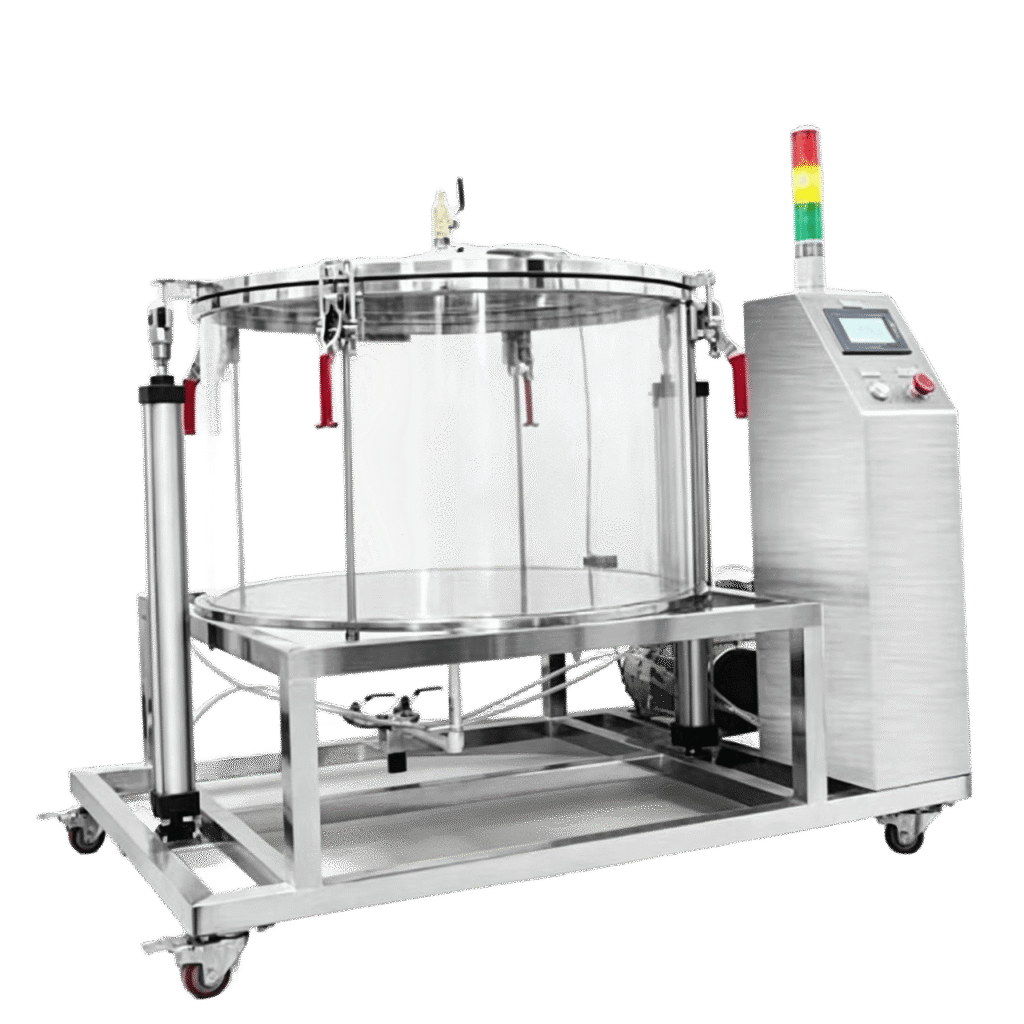
Having great lab equipment doesn't prevent operator error on the factory floor. That’s why our production center runs on a fully integrated Manufacturing Execution System (MES) tied directly to automated dosing and mixing equipment.
In many traditional plants, an operator reads a paper recipe and manually dumps raw silanes or fillers into a vessel. If they add 2% too much plasticizer, nobody notices until customer complaints come in three months later. At leakproof, our digital production system eliminates that human factor. Raw material containers are barcoded. The automated dosing pumps won't unlock unless the MES scans and verifies the exact raw material lot number matching the DCC master recipe.
Key parameters—temperature, vacuum levels, dispersion power, and mixing times—are logged in real-time. If a vacuum level drops for even 30 seconds during the de-aeration phase of a heavy-duty sealant batch, the MES flags the entire lot for quarantine automatically.
The Industry Reality Check: Standard industry practice often relies on end-of-line testing—checking a batch after it's fully packaged. At leakproof, our MES tracks in-process inline parameters at every stage of compounding. We don't just ask "Did the finished product pass?" We know the exact thermal and shear history of every drum that leaves our dock.
Formulation testing covers routine batch release, but structural waterproofing demands long-term certainty. We regularly pull production samples for full Type Testing (Type Approval)—evaluating accelerated weatherability over thousands of hours, artificial aging, and fatigue resistance under dynamic movement.
When you choose a leakproof liquid coating or heavy-duty sealant, you aren't getting a batch that was hastily mixed based on a theoretical recipe. You are getting a material backed by a rigid, multi-layered quality ecosystem—from deep silicone polymer science to strict digital manufacturing controls. That is how we ensure that when our product goes into your facility or project, water stays exactly where it belongs: out.
"Let’s be honest: when a seal holds up, nobody talks about it. It’s only when water starts dripping through a joint that everyone suddenly cares about adhesive engineering. We build leakproof products so you never have to think about us after the job is done."